NGO website development case study in India – Jivika Foundation
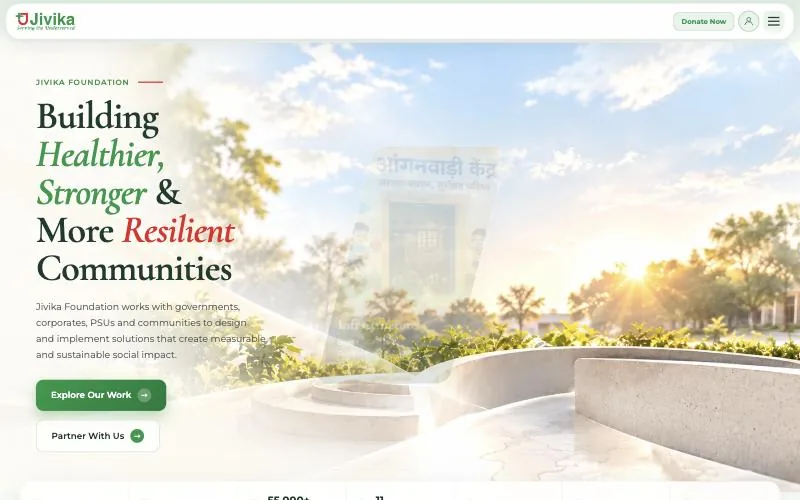
Answer first: Govindani Infotech rebuilt the Jivika Foundation website to serve corporate, PSU and government audiences that evaluate NGOs with the same rigor as a due‑diligence pack. By organising information around six programme verticals, displaying impact metrics up front, and presenting partner testimonials as evidence, the new site lets a CSR decision‑maker assess fit, scale and credibility without needing to request additional material.
The Challenge
Jivika Foundation’s funding model relies on large corporate donors, public‑sector undertakings and government programmes rather than retail contributors. The people who approach the site are senior CSR managers who need to verify a programme’s architecture, existing partnerships and measured outcomes before they can recommend an allocation internally. Traditional NGO sites tend to foreground emotional appeal, place donate buttons prominently and hide evidence several clicks deep. For a CSR head, that layout creates friction: the required data is buried, and the site does not read like a structured due‑diligence document. Jivika needed a digital presence that spoke directly to this audience, presenting verifiable information in a clear, audit‑friendly format while still allowing public donations in a low‑key manner.
What Govindani Built
Govindani approached the brief by treating the website as an institutional case study rather than a fundraising appeal.
Programme‑led architecture: Six core areas of work—health, education, rural development, climate, sport and public infrastructure—each received a dedicated section. This lets a potential partner navigate directly to the vertical that aligns with their CSR mandate, without wading through unrelated content.
Transparent delivery method: The foundation’s five‑step delivery method (understand, design, partner, implement, measure) is displayed openly on the site. By making the process visible, the site itself becomes an audit trail that partners can reference.
Impact metrics front‑loaded: Key figures—2.9 million people served, 25 000+ medical camps, 55 000+ girls vaccinated against HPV, coverage across 11 states and 100 + towns—are placed above the fold and reiterated at the end of the page. This immediate exposure satisfies the data‑driven expectations of corporate reviewers.
Evidence‑focused storytelling: Field stories now carry named individuals and locations, replacing generic stock imagery. Partner logos and CSR‑specific testimonials are positioned as proof points rather than decorative elements.
Dual enquiry pathways: A quiet donation ask remains on the site for the public, while a separate, prominent CSR/partnership enquiry form is provided for institutional visitors. This separation preserves the institutional tone for corporate users while still supporting public contributions.
The resulting site can be explored at the live address: jivika.org.
The Result
The rebuilt site now showcases Jivika’s own impact numbers right at the top of the homepage, allowing a CSR reviewer to gauge scale instantly. The 50 + corporate and 9 PSU partnerships are displayed alongside the metrics, giving immediate context to the foundation’s credibility. Because the information architecture mirrors the way a due‑diligence pack is structured, a CSR team can assess fit, scale and credibility without sending a single email for clarification.
Qualitatively, the site has shifted the visitor experience from an emotional appeal to an evidence‑driven briefing. Partners report that they can locate the programme vertical relevant to their mandate, understand the delivery process, and see verifiable outcomes within a few clicks. The quiet public donation option remains available but no longer competes with the institutional narrative, preserving the professional tone required for high‑value corporate engagement.
What This Means If You Run a Similar Organisation
If your NGO’s funding comes primarily from corporate CSR budgets, government programmes or PSU partnerships, consider the following practical takeaways:
Structure content around partner priorities. Identify the verticals or impact areas that align with typical CSR mandates and give each a dedicated, easy‑to‑navigate section.
Place verifiable metrics up front. Numbers that demonstrate reach, scale and outcomes should appear above the fold, mirroring the summary tables found in due‑diligence packs.
Make your delivery process visible. A clear, step‑by‑step description of how you design, implement and measure programmes acts as an implicit audit trail and builds trust.
Use real stories as evidence. Named beneficiaries and specific locations lend authenticity far more than generic images, especially when your audience is looking for concrete proof of impact.
Separate institutional and public pathways. A discreet public donation option can coexist with a prominent partnership enquiry form, ensuring each audience receives the tone and information they expect.
Show partner endorsements as proof, not decoration. Logos and testimonials placed alongside impact data reinforce credibility without appearing merely decorative.
By aligning the website’s information architecture with the expectations of corporate and government reviewers, you reduce friction, shorten the decision‑making cycle and position your organisation as a transparent, accountable partner.
For organisations interested in a similar transformation, Govindani Infotech can discuss how to adapt these principles to your context. Get in touch via the contact page.
Frequently Asked Questions
How does a programme‑led information architecture differ from a typical NGO site?
A programme‑led architecture groups content by the specific interventions or sectors the NGO works in, rather than by fundraising appeals. This allows a corporate CSR manager to navigate directly to the area that matches their internal mandate, saving time and presenting information in a familiar, structured format.
Why are impact numbers placed above the fold?
Corporate and government reviewers look for quantitative evidence of scale and effectiveness early in their assessment. Presenting key metrics immediately satisfies that need and reduces the number of clicks required to find essential data.
Is a public donation button still necessary for an NGO that mainly receives corporate funding?
Yes, but its placement and visual weight should reflect the organisation’s primary audience. A discreet donation option allows the public to contribute without detracting from the institutional tone required for high‑value corporate engagement.
What role do partner testimonials play on the site?
Partner testimonials act as third‑party verification of the NGO’s work. When displayed alongside impact metrics and programme details, they reinforce credibility and demonstrate that other reputable organisations have already endorsed the partnership.
Can the five‑step delivery method be customised for different programmes?
The method itself—understand, design, partner, implement, measure—is a framework that can be applied across all verticals. Specific activities within each step can be detailed per programme, providing both consistency and the flexibility to address programme‑specific nuances.
This case study reflects the factual information provided by Jivika Foundation and Govindani Infotech. All figures and descriptions are drawn directly from the brief and the live site.