Ecommerce Website Development Case Study in India – GSD Organics
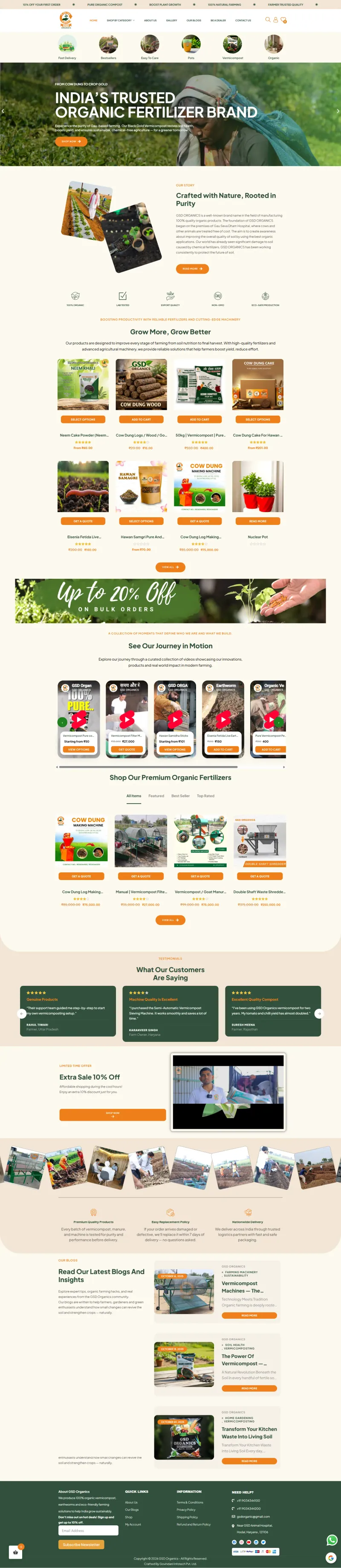
Answer first: Govindani Infotech helped GSD Organics turn a highly sceptical, evidence‑driven farmer audience into confident online shoppers by making product information concrete, aligning the site’s voice with farming credibility and introducing a low‑risk first‑order trial. The result is a storefront that speaks the language of growers, removes the hesitation around trying new inputs and integrates payment and delivery in a way that matches the expectations of Indian agriculture buyers.
The Challenge
GSD Organics supplies organic compost and other farming inputs to a market that tests every claim against a single cropping season. Farmers who buy online are accustomed to measuring yield improvements directly; if a product does not deliver, the loss of trust is immediate and lasting.
Two specific barriers existed:
- Evidence‑driven scepticism – Buyers demand clear, measurable details about composition, application rates and expected outcomes. Vague marketing language is penalised.
- Risk of first‑time purchase – An unfamiliar organic input represents a financial gamble for a farmer who cannot afford a failed experiment. The perceived risk outweighs any price advantage.
A traditional e‑commerce approach that leans on generic wellness messaging would not resonate with this audience, and overselling could irreparably damage the brand’s credibility.
What Govindani Built
Govindani’s solution focused on three inter‑locking pillars, each directly addressing the challenges identified.
1. Concrete product claims
Every product page now lists the exact composition of the compost or input, the recommended application method, and the measurable benefits a farmer can expect. The language avoids superlatives and instead presents factual data that can be cross‑checked in the field.
2. Farming‑centric positioning
The site’s tone and visual cues were reshaped to reflect a farmer’s perspective rather than a consumer‑wellness narrative. Taglines such as “Pure Organic Compost – Boost Plant Growth” and “Made for Indian Soil” echo the language farmers use when they discuss their own practices. This alignment reinforces the brand as a peer rather than an external promoter.
3. First‑order trial mechanic
A 10 % discount on the first order was introduced as a tangible incentive for new buyers. The discount is coupled with clear guidance on how to trial a small quantity, allowing the farmer to evaluate the product with minimal financial exposure.
All of these elements sit within a seamless checkout flow that integrates payment processing and pan‑India delivery, ensuring that once a farmer decides to try, the order can be fulfilled reliably.
The Result
The revamped site now delivers product information that satisfies the evidence‑driven buyer. By foregrounding specific composition and usage details, the platform removes the ambiguity that previously caused hesitation.
The first‑order trial mechanic has lowered the barrier for sceptical customers, giving them a low‑risk path to experience the product’s benefits. While the client has not disclosed quantitative conversion figures, the qualitative feedback indicates that farmers are more willing to place an initial order because the risk is clearly mitigated.
Overall, the site now reflects three core highlights:
- Specific composition and usage detail – replacing vague marketing claims with factual data.
- Farming‑credibility positioning – speaking directly to the farmer’s identity and concerns.
- First‑order trial incentive – a concrete, low‑risk entry point for new customers.
These improvements align the digital experience with the expectations of Indian agriculture buyers, preserving GSD Organics’ reputation for reliability while encouraging growth in online sales.
What This Means If You Run a Similar Organisation
If your organisation serves a market that values proof over persuasion, the GSD Organics case offers several practical takeaways:
- Prioritise factual product data – Detail the exact ingredients, recommended dosages and measurable outcomes. Farmers (or any evidence‑driven buyer) will compare these figures with their own observations, so clarity is essential.
- Adopt the buyer’s voice – Use terminology and visual cues that mirror the language of your target sector. A farmer‑centred tone builds trust faster than generic wellness or lifestyle messaging.
- Offer a low‑risk entry point – A modest discount or a trial‑size offering reduces the perceived gamble of a first purchase. Pair this with clear guidance on how to test the product, and the buyer’s confidence rises.
- Integrate payment and logistics seamlessly – Even when the product itself is the focus, a smooth checkout and reliable delivery are non‑negotiable for repeat business.
- Avoid over‑promising – In a market where results are quickly validated, any claim that cannot be substantiated will damage credibility. Stick to verifiable facts and let the product’s performance speak for itself.
By applying these principles, organisations can build e‑commerce experiences that respect the rational decision‑making process of their customers, rather than trying to persuade them with generic hype.
Frequently Asked Questions
How can I make my product pages more evidence‑driven without overwhelming the buyer?
Present the most critical data—such as composition, application rates and expected yield impact—in a concise, bullet‑point format. Use headings that mirror the questions a farmer would ask, and keep any supplementary information in expandable sections to keep the page tidy.
Is a first‑order discount enough to convince sceptical buyers?
A discount helps, but it works best when combined with clear guidance on how to trial a small amount of the product. The aim is to lower financial risk while giving the buyer a concrete plan for evaluation.
Should I completely abandon consumer‑wellness language for a farming audience?
Not necessarily. The key is to balance any wellness messaging with farming‑specific benefits. If the product also supports soil health, frame that benefit in terms of crop performance and long‑term farm sustainability, rather than generic health claims.
What role does site positioning play in building trust with agricultural buyers?
Positioning that reflects the buyer’s identity—using phrases like “Made for Indian Soil” or “Farmer Trusted Quality”—signals that the brand understands the buyer’s context. This alignment reduces the perception of an outsider trying to sell a product, thereby strengthening trust.
How important is seamless payment and delivery integration for an agriculture e‑commerce site?
Very important. Even the most compelling product information will not convert if the checkout process is cumbersome or delivery is unreliable. Integrating payment and logistics ensures that once a farmer decides to try, the experience remains positive.
Where can I see the final result for GSD Organics?
Visit the live site at gsdorganics.com to explore how the product information, farmer‑centred messaging and first‑order trial incentive have been implemented. If you are interested in a similar transformation for your organisation, get in touch through our contact page.